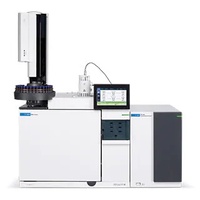
Pulsed Discharge Detector (PDD)
The pulsed discharge detector (PDD) utilizes a stable, low-powered, pulsed DC discharge in helium as the ionization source. Performance is equal to or better than GC detectors with conventional radioactive sources. In the helium photoionization mode, the PDD is a universal, non-destructive, high sensitivity detector. In the electron capture mode, the PDD is a selective detector for monitoring high electron affinity compounds such as freons, chlorinated pesticides, and other halogen compounds.
VICI PDDs (pulsed discharge detectors) utilize a stable, low powered, pulsed DC discharge in helium as an ionization source. Eluants from the column, flowing counter to the flow of helium from the discharge zone, are ionized by photons from the helium discharge. The bias electrode(s) focus the resulting electrons toward the collector electrode, where they cause changes in the standing current which are quantified as the detector output. Performance is equal to or better than detectors with conventional radioactive sources.
In the electron capture mode, the PDD is a selective detector for monitoring high electron affinity compounds such as freons, chlorinated pesticides, and other halogen compounds. For this type of compound, the minimum detectable quantity (MDQ) is at the femtogram (10-15) or picogram (10-12) level. The PDD is similar in sensitivity and response characteristics to a conventional radioactive ECD, and can be operated at temperatures up to 400°C. For operation in this mode, He and CH4 are introduced just upstream from the column exit.
In the helium photoionization mode, the PDD is a universal, non-destructive, high sensitivity detector. The response to both inorganic and organic compounds is linear over a wide range. Response to fixed gases is positive (increase in standing current), with an MDQ in the low ppb range. The PDD in helium photoionization mode is an excellent replacement for flame ionization detectors in petrochemical or refinery environments, where the flame and use of hydrogen can be problematic. In addition, when the helium discharge gas is doped with a suitable noble gas, such as argon, krypton, or xenon (depending on the desired cutoff point), the PDD can function as a specific photoionization detector for selective determination of aliphatics, aromatics, amines, as well as other species.
Available for 110 VAC and 230 VAC.
Model D-2 Stand-Alone Pulsed Discharge Detector
The D-2 is a dual mode, universal detector system which can be retro-fitted to your older GC. The D-2-I is optimized for trace level work in the helium photoionization mode. The stand-alone systems include detector, controller, electrometer, helium purifier, and power supply.
|
Description |
VAC |
Product No. |
|
Mode-selectable universal electron capture/photoionization detector system |
110 |
D-2 |
|
230 |
D-2-220 |
|
|
Detector system optimized for packed columns and trace level work in helium photoionization mode |
110 |
D-2-I |
|
230 |
D-2-I-220 |
Plug-and-Play Detectors for Agilent 6890 and 7890
Model D-3 is designed for plug-and-play installation on the popular Agilent 6890 and 7890, and is optimized for trace level work in the helium photoionization mode. The D-3 utilizes the electronics and power supply of the host GC.
|
Description |
Plug-and-play for: |
VAC |
Product No. |
|
Model D-3 helium photoionization detector |
Agilent 6890 |
110 |
D-3-I-HP |
|
230 |
D-3-I-HP-220 |
||
|
Agilent 7890 |
110 |
D-3-I-7890 |
|
|
230 |
D-3-I-7890-22 |
Plug-and-Play Detectors for Other GCs
Pulsed Discharge Detector Model D-4 is single mode, optimized for trace level work in the helium photoionization mode. Versions are available for easy installation on the Varian 3800; Shimadzu 14, 17, 2010, and 2014; ThermoFinnigan Trace, Mega, and Top; and Hewlett Packard 5890. With the exceptions of the universal version and the HP 5890 version, the detectors use the FID electrometer of the existing GC.
|
Specialized detector for: |
VAC |
Product No. |
|
HP 5890 |
110 |
D-4-I-HP58 |
|
230 |
D-4-I-HP58-220 |
|
|
Shimadzu GC 14 * |
110 |
D-4-I-SH14-R |
|
230 |
D-4-I-SH14-R-220 |
|
|
Shimadzu GC 17, 2010, 2014 * |
110 |
D-4-I-SH17-R |
|
230 |
D-4-I-SH17-R-220 |
|
|
Thermo Trace GC * |
110 |
D-4-I-TQ-R |
|
230 |
D-4-I-TQ-R-220 |
|
|
Varian 3800 * |
110 |
D-4-I-VA38-R |
|
230 |
D-4-I-VA38-R-220 |
|
|
All other GCs |
110 |
D-4-I |
|
230 |
D-4-I-220 |
* Uses the existing GC FID electrometer
miniPDD Helium Ionization Detector
The newest member of the PDD family is also the smallest and thriftiest. The miniPDD uses about one fifth (20%) the amount of helium as the D-3 and D-4 versions, giving up only a bit of sensitivity and dynamic range in return. It is approximately one half the size of the D-4, but has nearly the same sensitivity — about 100 ppb for fixed gases. With its reduced size, weight, and helium consumption, it is particularly well suited to portable applications, or to any situation in which the high cost of helium becomes a consideration. It can be paired with other Valco components (controller, pulse module, helium purifiers, etc.) or can be purchased alone for use with existing components.
|
Description |
Product No. |
|
miniPDD helium photoionization detector, cell only |
PD-D2-IM |