Skip to Content

PYROPROBE 6000, 6150 Y 6200

CDS Pyrolyzers are much more than a polymer introduction system. Actually the new Pyroprobe 6000 Series are so advanced that they are now considered as thermal injection systems that can tackle the most difficult chromatography sample matrix, whether solid, liquid or gas.

The CDS pyroprobe 6000 Series use a reliable and repeatable platinum filament heating system. The microprocessor in the electronics controls the temperature of the filament by calculating the resistance of the filament at the set point temperature and supplying the correct voltage to achieve that temperature. An incredible maximum heating rate of 20,000C/second is achievable, which assures the most consistent scission of polymers for unmatched quantitative accuracies and repeatability.

CDS pyrolyzers can be used in university, forensic labs, labs, government settings, and more for all your polymer research needs. They are also compatible with all major brands of GCMS including: Agilent, Bruker, PerkinElmer, and Shimadzu.


CDS Pyrolyzers are fully programmable with the widest temperature settings and ramp rates in the industry. With proper accessories and programming, the instruments can be used for Evolved Gas Analysis (EGA), Thermal Desorption, Reactive Gas Pyrolysis, Dynamic Headspace, High-Pressure Pyrolysis, Direct PY-MS, PY-FTIR, and even catalyst testing.
Probes are available in a variety of designs and sizes, including a flat ribbon probe where the sample is directly placed on the platinum for maximum heat transfer, and a coil probe, where samples are inserted into quartz tubes or boats before inserting into the coil filament. Also, we now offer an easy to use "Drop In Sample Chamber" (DISC probe) that eliminates the need to insert the sample tube into the coil probe.
All 6000 series instruments come with a LCD touch screen for local control and a Windows-based operating software package.
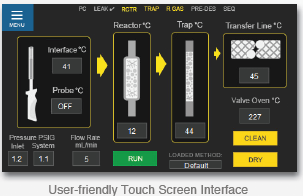
 

The LCD screen allows for local start/stop of the py-GCMS system as well as displays current settings and running temperatures and pressures.
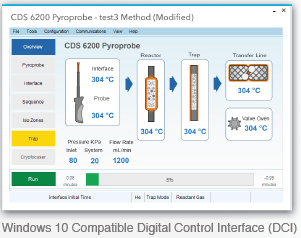
 
The easy to use Windows software runs on the same PC that is controlling your GC. The system comes with 50 pre-programmed pyrolysis methods so you can quickly be on your way after installation.
 
The CDS Pyroprobe 6150
 The 6150 is the model instrument for pyrolyzing in GC carrier gas only. The 6150 connects to any model GC with a heated sample line for easy on/off installation. A low-mass programmable interface allows for thermal desorption of volatiles before pyrolyzing the sample.
 Basic program features include:
  • Programmable Temperature Range: From ambient to 1400°C, in 1C increments
  • Temperature Accuracy: +/- 1°C
  • Heating Rates:
0.01°C/ms to 20.0°C/ms
0.01°C/sec to 999.9°C/sec
0.01°C/min to 999.9°C/min
  • Probe Clean and Sample Dry: Temperatures are user-selectable
  • Steps: Up to 10 temperature profiles with a GC start per step. Allows for multiple thermal desorption or pyrolysis steps on each sample.
  • Interface Type: Low-mass programmable zone to assist in thermal extraction or evolved gas studies
  • Interface Temperature: Settable in 1°C increments to 400°C
  • Interface Heating Rates: Programmable in 1°C/min to 100°C/min
  • GC Connection: Heated sample line through injection port; programmable to 375°C
  • Valve Oven: Settable in 1°C increments to 350°C
  • Dimensions: 381 mm (15") W x 292.1 mm (11.5") H x 406.4 mm (16") D
  • Weight: 16.3 kg (36 lb)
 
The CDS Pyroprobe 6200
Includes all 6150 functionality plus these Value-Added features:
A built-in analytical trap which enables the instrument to collect analytes using slow rate pyrolysis, use a reactant gas (like oxygen), or perform thermal desorption on sorbent tubes or larger samples. The unique interface design permits direct pyrolysis in carrier gas to the GC inlet, or heating and transfer to the trap, before being introduced to the GC. An optional test tube desorber can be heated up to 300°C for running dynamic headspace experiments on larger samples. Optional external DHS chambers of 130Ml AND 800Ml are also available.
Pyrolysis and interface programming same as 6150.

Analysis of Acrylate Polymers by Direct Pyrolysis-FT-IR.pdf Analysis of Photocopier Toners by Pyrolysis-FT-IR.pdf Analysis of Poly (vinyl chloride) by Direct Pyrolysis FT-IR.pdf Analysis of Polyolefins by Pyrolysis Gas Chromatography.pdf Analytical Pyrolysis of Surfactants.pdf Capillary Gas Chromatography of Polyolefin Pyrolysates.pdf Degradation Mechanisms-Depolymerization.pdf Degradation Mechanisms-Random Scission.pdf Degradation Mechanisms-Side Group Elimination.pdf Direct Pyrolysis-FT-IR. An Alternative Sampling System.pdf Dynamic Headspace and Pyrolysis in Ink Analysis.pdf Epoxy and Polycarbonate.pdf Evolved Gas Analysis of a Polyurethane Foam.pdf Evolved Gas Analysis of Polymers.pdf On-Column Cryofocusing for Improved Sensitivity Using Cryogenic Focusing.pdf Parameter Optimization in Pyrolysis-FT-IR.pdf Pyrolysis Gas Chromatography of Amino Acids.pdf Pyrolysis and FGA of Polyvinyl Alcohol.pdf Pyrolysis GC-MS of Biodegradable Plastic Packaging.pdf Pyrolysis of Fluoropolymers Polyvinyl Fluoride vs. Polyvinylidine Fluoride.pdf Pyrolysis of Synthetic Polymers-Improved Sensitivity Using Cryogenic Focusing.pdf Pyrolysis-FT-IR of Carbon-Filled Rubbers.pdf Pyrolysis-GC of Carbon-Filled Rubbers.pdf Pyrolysis-GC of High and Low Density Polyethlene.pdf Pyrolysis-GC of Polyolefins.pdf Pyrolysis-GC-MS of Power Coatings.pdf Pyrolysis-MSD for Rapid Polymer Analysis.pdf Pyrolytic Injection Inlet Autosampling System for the Analysis of Polymer Samples,.pdf Quantitation of Ethylene-Propylene Copolymers.pdf Quantitation of Low Levels of Methyl Methacrylate in a Copolymer.pdf Quantitative Determination of Poly (propylene-1-butene).pdf Quantitation of Epoxy to Hardener Ratios in a Cycloaliphatic Epoxy.pdf Quantitative Pyrolysis-GC in the Analysis of Copolymers.pdf Thermal Degradation of Polymers in Air.pdf Two-Step Polymer Analysis.pdf Using a Thermal Technique to Extract Residual Oligomers.pdf

Air freshener fragrances using Pyroprobe Microtrap.pdf Analysis of a Layered Paint Sample using Pyrotomy.pdf Analysis of Algae using Pyrolysis and THM.pdf Analysis of Cosmetics by Pyrolysis-GC-MS.pdf Analysis of Vulcanized Rubber by Pyrolysis-GC-MS,.pdf Antioxidant Detection in Petroleum Wax.pdf Biochemical Analysis by Pyrolysis-GC-MS.pdf Brominated Flame Retardant in PET.pdf Brominated Flame Retardants in a Polycarbonate.pdf Cracking Products of Oleic Acid and Olive Oil.pdf Detecting Differences in PEEK Preparation.pdf Four-Step Analysis of Smokeless Tobacco.pdf GC-MS of Plant Material.pdf GC-MS of Switchgrass.pdf Multi-step Analysis of Packaging Tape.pdf Multi-step Pyrolysis-GC-MS Analysis of a PVC Copolymer.pdf Pyrolysis Autosampling Reproducibility.pdf Pyrolysis GC-MS of Plant Derived (Cellulosic) Textiles.pdf Pyrolysis GC-MS to Characterize Artificial Sweeteners.pdf Pyrolysis of Fiber Blends.pdf Pyrolysis of Rubber with Antioxidant 6-PPD.pdf Pyrolysis of Soy Clothing Fiber.pdf Pyrolysis of Tobacco in Air.pdf Pyrolysis-GC-MS of Polyurethanes.pdf Pyrolysis-GC-MS of Tobacco with Menthol.pdf Tri-Step Analysis of a Latex Glove.pdf Tri-Step Analysis of Chewing Gum.pdf Injections using Pyroprobe.pdf Evaluation of Source Rock using EGA and Pyrolysis GCMS.pdf Py-GC HR-TOF of Circuit Board Polymer.pdf Pyrolysis and Reactant Gas to Detect and Study Antimicrobial Agents.pdf Pyrolysis of Coal Under Steam and Elevated Pressure PYGC.pdf Detection of Polymers Dissolved in Sea Water.pdf EGA and the Identication of a Clear Polymer.pdf Multi-Step Analysis of Automobile Tire Rubber.pdf Multi-Step Analysis of Coal by Pyrolysis-GC_MS.pdf Tri-Step Analysis of food Packaging.pdf Thermal Extraction of Coffee, Tea and Cocoa.pdf Pyrolysis GC_MS of Biodegradable Plastic Packaging.pdf Thermal Extraction of Oligomers in a Plastic.pdf A Comparison of Nylons by Pyrolysis GC.pdf A Comparison of Polyolefins dy Pyrolysis GC.pdf Pyrolysis-GC of Natural Fibers.pdf Dynamic Headspace and Pyrolysis in Ink Alalysis.pdf Analysis of Polyolefins by Pyrolysis GC.pdf Pyrolysis -GC_MS and FGA of Poly Vinyl Alcohol.pdf Using a Standalone Bulk Headspace Sampling Vessel with a Pyroprobe Study Rubber Volatiles.pdf Orange Juice-Fresh and from Concentrate.pdf Pyrolysis of the Bisphenol A Polymers Epoxy and Polycarbonate.pdf